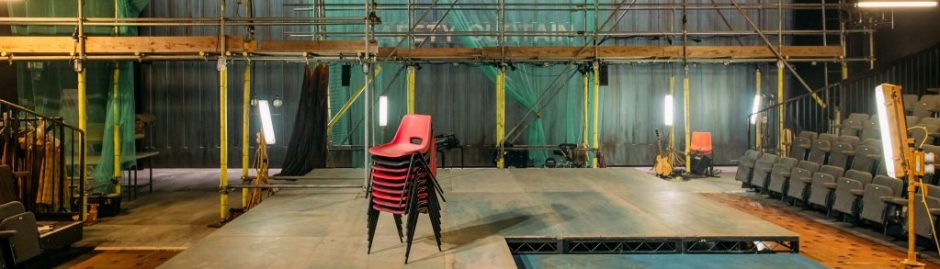

“If there are other little girls out there with limb differences then I want to be their representation.” ( Marshall 2020)
In my context as a theatre designer and part time lecturer in design for performance, the conversation between these two parts of my life often informs my teaching practice. I teach the first year of our BA courses and am conscious that this important year sets the tone for a student’s experience and sense of themselves within a university setting. I think that visual representation – seeing yourself in a context, is a key part of belonging. This must inform the materials that we use to teach our cohorts. As designers we need to feel empowered and included but also have the ability, through the characters we create, to empower and include our audiences.
“Through the visibility of minority artists and cultures, representation can serve as a source of inspiration, creativity, and self-expression ” (Johansson, Tienari, and Wickström. 2023)
In my practice I work with a wide range of actors of diverse backgrounds and body types covering many of the protected characteristics, who play characters that similarly represent a huge range of humanity. I have looked for ways to share this experience of various bodies and how it has educated and challenged me with my students. When making costume drawings and hair and make-up designs, I notice that they often default to white thin “fashion” body templates. I feel there is a need to disrupt this habit and give the students the opportunity to work with many types of body.
There are financial barriers to bringing in diverse models for drawing sessions that I have run. Therefore, I am planning to produce an image bank of diverse figure references for the Performance programme that both staff and students can access. I have a collection of this kind already for my teaching of character analysis, drawing and creation but haven’t effectively curated it or made it available to other staff and students.
Looking back on some work the department undertook when considering inclusion, the need for this kind of resource came up a few times:
I will need to explore various platforms for sharing within UAL, perhaps creating an EDI hub on SharePoint that everyone can draw on and add to. I will need to find someone to overview it in terms of its representation, to be sure that I balance any potential unconscious bias.
Biography:
Johansson. J, Janne. T and Wickström .A. 2023. “The Power and Burden of Representing Diversity in a Performing Arts Organization: A Recognition-based Approach.” Gender, Work & Organization 30(6): 2014–2032. https://doi.org/10.1111/gwao.13040.
Longstaff. J June 16th 2020. ” Woman who lost her leg after being hit by a drunk driver as a child becomes a Vogue model” Metro https://metro.co.uk/2020/06/16/woman-who-lost-leg-hit-drunk-driver-child-becomes-vogue-model-12856155/
Hi Jess
I hope that you are well. Thank you for sharing your intervention design ideas. This comes across as a heartfelt, thoughtful intervention that is rooted in practice and recognises how subtle exclusions (e.g. defaulting to white thin “fashion” body templates) can shape student perception in the early stages of the journey, limit creative confidence, and undermine inclusion (LO2). You make a compelling case for embedding diverse visual representation in the foundational year of the programme, where student identity and belonging are being formed. (LO4)
The way your professional practice, coupled with understanding of relevant theory, informs teaching is a real strength here. I thought your Miro screenshots was a great asset and indeed useful in identifying a gap. You’re clearly aware of the need for critical representation (Johansson et al., 2023) and the risk of reinforcing normative aesthetics. I wonder if you could go further in making this intervention not just a resource bank, but also a pedagogical prompt. For example: how might students reflect on their own biases as they use the image bank? Could character briefs or reflective drawing tasks encourage them to confront inherited visual norms? (LO2)
In terms of platform and collaboration, developing the image bank through a shared SharePoint hub sounds like a good idea, just wonder if there is a way to ensure it stays relevant and balanced without adding too much to your workload. Could students or alumni contribute images? There is also an opportunity here to consider who ‘assesses’ representational breadth and your own positionality here (LO3), basically, who gets to decide what ‘diverse’ looks like. Also, which experiences, observations, discussions, reflections, readings have influenced your choice of intervention and your approach to it. It may also be good to consider how your intervention aligns/critiques/takes into account institutional and national policy/frameworks (LO1)
There are some resources below you may find useful and I’ve included the learning outcomes too to provide a focus for the reflective report when you come to it.
Regards, Victor
Potentially useful resources
You may want to have a look at UAL’s Zine project Decolonising the Arts Curriculum: Perspectives on Higher Education. [Zine project]. You may need to scroll down a bit https://decolonisingtheartscurriculum.myblog.arts.ac.uk/
Advance HE (2021). Embedding Inclusive Teaching and Learning
Offers guidance on aligning inclusive curriculum design with national HE policy.
https://www.advance-he.ac.uk/knowledge-hub/framework-inclusive-learning-and-teaching
Ahmed, S. (2012) On Being Included.
Schiffer, A. (2020). Positionality in Design.
FACE (2021). Power and Privilege in Fashion Education. [online] Fashion Academics Creating Equality (FACE), CHEAD.
https://www.chead.ac.uk/fashion-academics-creating-equality-face-blog-piece-power-and-privilege/
Below, just a reminder of the learning outcomes.
LO1: Critically evaluate institutional, national and global perspectives of equality and diversity in relation to your academic practice context. [Enquiry]
LO2: Manifest your understanding of practices of inequity, their impact, and the implications for your professional context. [Knowledge]
LO3: Articulate the development of your positionality and identity through the lens of inclusive practices. [Communication]
LO4: Enact a sustainable transformation that applies intersectional social justice within your practice. [Realisation]